

Robust Q2 2026 results, target upgrades, and new capital momentum – Eurobank remains Deutsche Bank's top pick
Greek and Cypriot banks continue to report strong performance, with better-than-expected second-quarter 2026 results clearing the path for even more positive prospects. This is highlighted by Deutsche Bank, which sees significant upside potential for the banking sector, arguing that the market has not yet fully priced in the accelerating fundamental metrics. At the center of this trend are robust credit expansion, resilient net interest income, and improving operational efficiency, while exceptional asset quality further enhances earnings visibility.
The 3Rs: Resilience, returns, and rerating
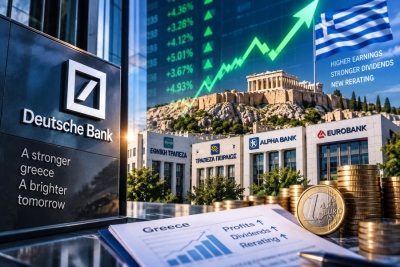
Deutsche Bank summarizes its investment thesis for Greek banks around three main pillars: Resilience, Returns, and Rerating. According to Deutsche Bank, the second-quarter data confirms that the outperformance of the Greek and Cypriot banking sectors is not circumstantial, but underpinned by strong operational momentum. Corporate credit expansion remains particularly robust, with corporate loan growth reaching approximately 10% year-on-year. At the same time, net interest income (NII) demonstrates resilience, as rising volumes offset pressures from the interest rate environment. This dynamic has already prompted bank management teams to raise their full-year 2026 guidance, while strict cost discipline drives further improvement in efficiency ratios.
NPEs at 2.2% – Strong earnings visibility
Another major advantage for the Greek banking sector is asset quality. The average non-performing exposure (NPE) ratio has dropped to around 2.2%, a level that Deutsche Bank believes significantly enhances future earnings visibility. The German investment bank considers that strong profitability, combined with exceptional asset quality, has not been fully priced in by the market. In fact, Deutsche Bank estimates that Greek banks offer higher growth prospects compared to many European peers, creating ample room for further valuation rerating.
New investors coming via Stoxx and FTSE Russell
Revisions to international equity indices are expected to serve as a catalyst for the sector. Greece's strong macroeconomic outlook sets the stage for major index upgrades, including potential migrations within Stoxx and FTSE Russell in September, ahead of Greece's expected reclassification to developed market status by MSCI in May 2027. Although Deutsche Bank notes that the immediate impact from initial capital inflows may be modest, these index changes carry broader strategic significance. Crucially, they open the door for Greek banks to access developed market institutional investors, who manage vastly larger capital pools.
Strong capital, buybacks, and dividends near 10%
The capital strength of the Greek banking system serves as another vital factor. Deutsche Bank points out that solid growth is backed by a robust capital base, while reliance on deferred tax credits (DTC) is no longer a concern. This development creates greater flexibility for shareholder capital returns, including potential share buyback programs. Furthermore, Deutsche Bank sees the potential for dividend yields approaching double digits through 2028. Based on these factors, the German bank views the current environment as a particularly attractive entry point for investors.
Eurobank: Deutsche Bank's top pick
Despite the strong rally already logged by banking equities, Deutsche Bank maintains a Buy rating on all banks under its coverage in Greece and Cyprus. Its top pick remains Eurobank, maintaining a Buy rating while raising its price target to 5.45 euros per share, up from 5.00 euros previously. According to Deutsche Bank, Eurobank is well positioned to capture significant additional upside by leveraging its M&A growth strategy alongside a highly profitable financial profile. The bank estimates that Eurobank can continue to outperform market expectations.
Alpha Bank: Strong commercial momentum and M&A
Deutsche Bank also maintains a positive stance on Alpha Bank, reiterating its Buy rating and raising its target price to 5.10 euros, up from 4.80 euros. Alpha Bank benefits from solid underlying commercial momentum, as well as the successful integration of operations derived from M&A transactions. Additionally, the strategic involvement of UniCredit unlocks substantial long-term strategic capabilities.
Piraeus Bank: Confirming the turnaround story
For Piraeus Bank, Deutsche Bank retains its Buy rating, lifting its price target to 11.30 euros from 10.15 euros. According to Deutsche Bank, the lender continues to validate its powerful turnaround story, which is now further bolstered by the integration of Ethniki Asfalistiki. This development adds fresh momentum to Piraeus Bank's operational and profitability profile.
National Bank of Greece: Strong profitability, but richer valuation
National Bank of Greece (NBG) remains among Deutsche Bank's top choices, featuring a Buy rating and a new price target of 18.55 euros, up from 17.10 euros. Deutsche Bank recognizes the bank's strong core profitability and exceptionally robust capital position. However, NBG represents Deutsche Bank's least preferred Greek bank selection due to its relatively higher valuation.
Bank of Cyprus: Solid profitability and attractive valuation
Finally, Deutsche Bank remains bullish on Bank of Cyprus, maintaining its Buy rating and raising its price target to 12.35 euros, up from 11.25 euros. The Cypriot lender has consistently delivered outstanding profitability and, according to Deutsche Bank, continues to present an exceptionally attractive investment choice.
The new target prices
Deutsche Bank has issued the following target price revisions:
-
Alpha Bank: Target price 5.10 euros, from 4.80 euros
-
Bank of Cyprus: Target price 12.35 euros, from 11.25 euros
-
Piraeus Bank: Target price 11.30 euros, from 10.15 euros
-
Eurobank: Target price 5.45 euros, from 5.00 euros
-
National Bank of Greece: Target price 18.55 euros, from 17.10 euros
The big play: A new rerating for Greek banks
Overall, Deutsche Bank's message is unequivocal: Greek banks have not exhausted their upward trajectory. Robust loan expansion, resilient net interest margins, dramatic improvements in asset quality, capital build-up, and expanding capacity for capital returns form a compelling investment mix. At the same time, potential reclassifications across international indices and the entry of new institutional investors could act as catalysts for a fresh equity rerating. Nevertheless, Deutsche Bank notes key downside risks, including a weaker-than-expected macroeconomic backdrop as well as potential delays or lower-than-anticipated capital distributions to shareholders.
www.bankingnews.gr












Σχόλια αναγνωστών